Flock Cameras in Indiana: License Plate Readers and Your Rights in a Traffic Stop
TL;DR: Thousands of automated license plate readers now operate across Indiana, including hundreds of fixed Flock cameras under contract with the Indianapolis Metropolitan Police Department. Indiana has no statewide statute setting minimum rules for how long that data is kept, who may search it, or how those searches are audited. For anyone facing charges, that matters: an automated alert identifies a vehicle sighting, not a driver, and under the Fourth Amendment an unverified hit does not automatically justify a stop, search, or arrest.
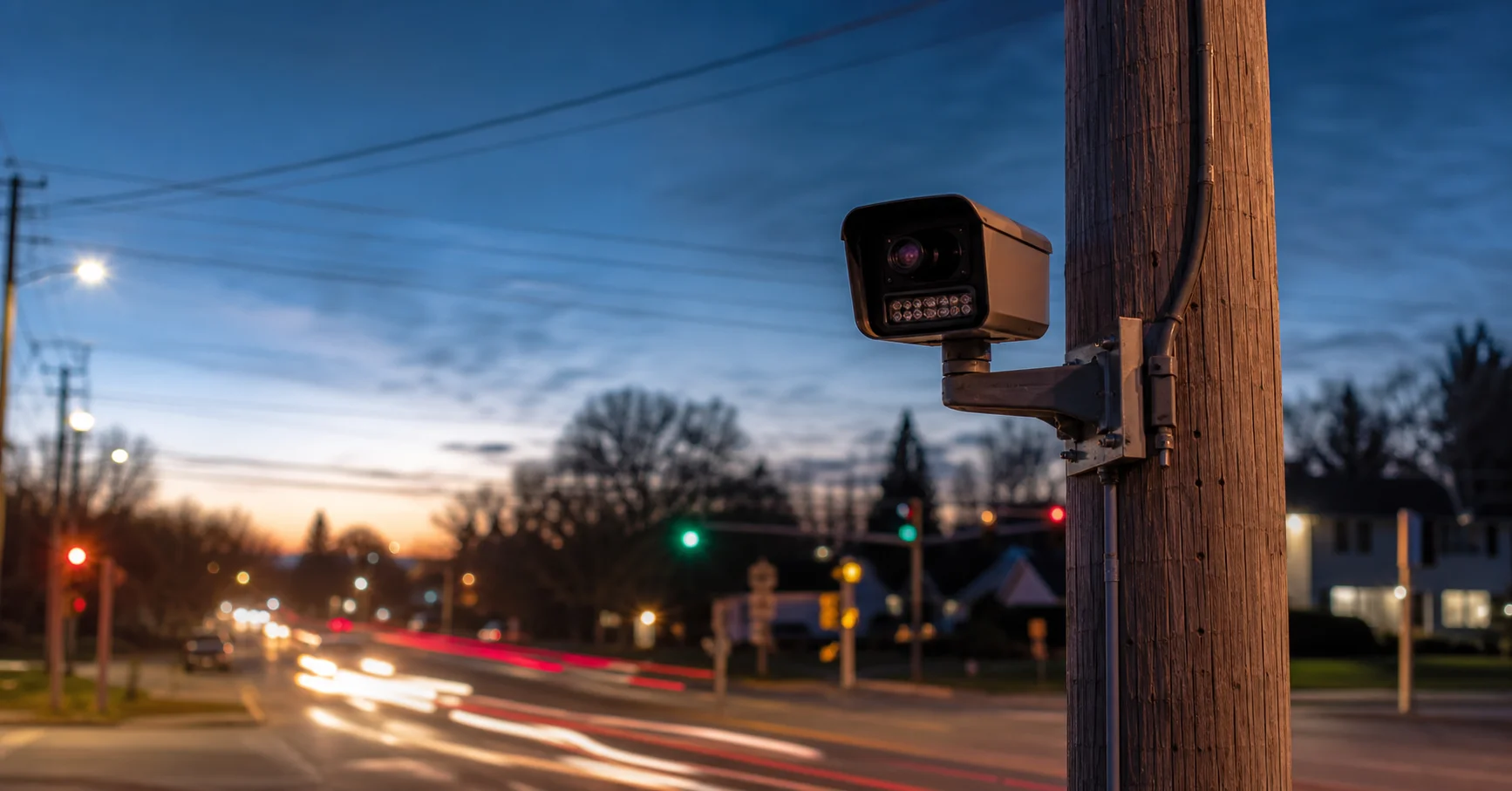
Most Hoosiers drive past automated license plate readers every day without noticing them. Mounted on poles at intersections, entrance roads, and highway ramps, these cameras photograph every passing plate, convert it to searchable text, and log the time and location of each sighting in a database that police can query later. In Indianapolis alone, IMPD’s agreement with Flock Group covers hundreds of fixed cameras, and advocacy groups have documented thousands more across the majority of Indiana’s 92 counties. In August 2026, that quiet infrastructure drew public attention when an IMPD officer was suspended over allegations of using license plate reader tools for personal reasons.
If your case began with an automated alert, understanding how Flock camera evidence in Indiana is generated — and where it is vulnerable to challenge — can matter a great deal to the outcome. To speak with an experienced and skilled criminal defense attorney about your situation, contact Keffer Hirschauer LLP today at 317-648-9560 or complete our online contact form to schedule a consultation.
How Flock Cameras in Indiana Actually Work
An automated license plate reader, or ALPR, is a high-speed, computer-controlled camera system that captures an image of every plate passing through its field of view, converts the characters into searchable data, and stores that record alongside a timestamp, a location, a camera identifier, and a contextual photograph of the vehicle. According to the Electronic Frontier Foundation, these systems can capture thousands of plates per minute — a volume no officer could approach manually.
Three Deployment Types of Flock Cameras in Indiana
Not all readers are the same, and the distinction matters when reconstructing how a case began.
- Fixed cameras are mounted on traffic signals, utility poles, highway ramps, or the entrances to a facility or subdivision. IMPD’s 275 confirmed Falcon devices fall into this category. When several fixed cameras line a single corridor, the resulting data can reveal a vehicle’s direction and rate of travel.
- Mobile readers are mounted on patrol vehicles and typically run for an entire shift. These capture parked cars as well as moving ones, meaning a single pass through a parking lot can log hundreds of plates.
- Trailer-mounted readers can be towed to a location and left in place for extended periods without permanent installation.
What the FLOCK System Records
A plate number and location are only the starting point. The photographs captured alongside each read can show the vehicle’s surroundings, and in some cases its occupants. Flock’s platform generates what the industry calls a “vehicle fingerprint,” indexing color, body type, make, model, visible damage, and distinguishing features such as roof racks or bumper stickers. That indexing is what allows an officer to search historical sightings using a partial plate — or no plate at all.
The system operates in two modes. In real time, it compares passing plates against preloaded hotlists and generates an alert on a match. Retrospectively, it allows an officer to query stored data by plate, partial plate, vehicle description, or location — for instance, entering an address to identify every vehicle recorded nearby during a given window.
Two features of hotlists deserve attention. First, they are not limited to serious offenses; hotlists frequently include low-level misdemeanors and traffic matters, and some agencies have used them to pursue unpaid fees and citations. Second, officers can add plates themselves, meaning a vehicle may be flagged based on an individual officer’s judgment rather than a verified warrant or theft report.
The Limitation That Matters Most for Flock Camera Evidence in Indiana
Here is the point most people overlook, and it is central to evaluating Flock camera evidence in Indiana: a read establishes that a particular vehicle passed a particular camera at a particular moment. It does not establish who was driving, who else was in the vehicle, or why it was there. ALPR data generally does not include a name at all — a name enters the picture only when an officer cross-references the plate against separate databases, adding another step where error can occur.
Nor does an alert confirm that the underlying hotlist entry is accurate or current. A plate can be misread. A recovered-vehicle report can go stale in the system. A similar plate from another state can trigger a false match. These are not theoretical concerns. In one widely reported California case, a woman was stopped at gunpoint, handcuffed, and searched after a reader misidentified her vehicle as stolen; the Ninth Circuit later held that the technology alone could not supply the basis for that stop. That ruling does not bind Indiana courts, which sit in the Seventh Circuit, but the underlying reasoning is instructive. A similar misread in Colorado led officers to detain a family, including children, over a vehicle that was never stolen.
The scale of collection compounds the issue. Because these systems record indiscriminately, the overwhelming majority of stored records belong to drivers with no connection to any offense. An EFF analysis of data from more than 60 California agencies found that a fraction of one percent of collected reads related to a public safety interest at the time of capture. Everything else is a record of an ordinary person going about an ordinary day — retained, searchable, and available to whoever holds access.
The Scale of Indiana’s Camera Network
The footprint is substantial. Volunteer mapping efforts have documented more than 3,500 automated license plate readers across Indiana, with over 3,100 identified as Flock hardware, spread across 84 of the state’s 92 counties. Those figures are crowdsourced lower bounds rather than an official inventory, and a county showing zero cameras may simply mean none have been documented there yet. In Marion County, roughly 610 devices have been mapped, though geographic totals reflect location rather than ownership and may include cameras operated by other agencies or private parties.
The Indianapolis contract itself, executed in January 2025, confirms 275 fixed Falcon license plate reader cameras already installed for IMPD, annual service charges of $687,500, and a term running through the end of 2028. It is worth noting that a contract price list is a purchasing menu, not proof of deployment — the agreement covers a range of products beyond the fixed cameras, but only those 275 devices are affirmatively identified as installed.
An Alert Is Not Automatically Probable Cause
This is where the defense analysis begins. Under IC 35-33-1-1, an Indiana officer may arrest without a warrant only in defined circumstances, and both the Fourth Amendment and Article 1, Section 11 of the Indiana Constitution require reasonable suspicion for an investigatory stop and probable cause for an arrest. An automated notification generated by software is not, standing alone, a substitute for either.
Indiana law enforcement has acknowledged as much internally. The Indiana State Police license plate reader standard operating procedure requires officers to validate an alarm before taking enforcement action and states that an alert by itself does not necessarily establish probable cause. That is a meaningful admission from the agency operating the technology. Notably, the IMPD contract with Flock contains no equivalent operational requirement — nothing in the agreement obligates an officer to independently confirm the plate, the issuing state, the vehicle description, and the current hotlist status before initiating a stop.
Indiana appellate courts have begun to encounter these facts. In a September 2024 memorandum decision, the Court of Appeals described officers receiving a Flock alert that helped locate a suspect, after which police relied on additional observations and evidence before acting. Under Indiana Appellate Rule 65(D), a memorandum decision issued after January 1, 2023 may be cited for persuasive value but is not binding precedent. Still, the pattern it describes is instructive: the alert functioned as an investigative lead that officers then corroborated. When corroboration is absent — when the stop rests on the notification and nothing more — a motion to suppress becomes a serious avenue for an Indiana criminal defense attorney to pursue.
What Indiana’s Regulatory Gap Means for a Pending Case
Indiana has no generally applicable statute establishing minimum standards for local law enforcement ALPR retention, access, sharing, auditing, or public reporting. Some agencies have adopted their own policies — the Indiana State Police and the Indiana Intelligence Fusion Center both maintain written rules covering logging and access — but those policies do not create a common floor binding every county and municipal department.
That absence cuts in an unexpected direction. Without a statutory framework dictating how searches are documented, the specifics of any individual query become a factual question that must be developed through discovery. Several issues are worth examining in any case built on Flock camera evidence in Indiana:
- Was the search logged? Was a case number, documented justification, or supervisory approval required at the time the query was run?
- Who ran it, and why? Was the officer conducting the search assigned to the investigation, or was access broader than the case warranted?
- What was retained, and where? The IMPD contract sets a rolling 30-day vendor default, but permits IMPD to download and archive records on its own systems with no contractual maximum.
- Who else received the data? The platform supports cross-jurisdiction sharing, and the contract does not publicly define which outside agencies may search or receive Indianapolis data.
- Was the alert verified? Did the officer independently confirm the plate, state, and hotlist status before the stop, or act on the notification alone?
The August 2026 IMPD Misuse Allegation
In August 2026, WTHR reported that IMPD suspended an officer over the alleged personal use of automated license plate readers. Important limits apply to what can responsibly be said about that report: the publicly available reporting does not establish who was searched, how many queries occurred, what the motive was, how the conduct was discovered, or whether criminal charges will follow. These are allegations, and they remain allegations unless and until established through official proceedings.
What the incident does demonstrate is that misuse of historical search tools is not a hypothetical concern. A system that can retrieve where a given vehicle has been over weeks or months can, in the wrong hands, be turned toward a former partner, a neighbor, or anyone else outside a legitimate investigation. For defense purposes, the practical lesson is that audit trails deserve scrutiny. If the origin of a case traces back to an ALPR query, the question of who ran that search and on what authority is a fair and often revealing one.
What To Do If Your Case Involves Flock Camera Evidence in Indiana
If an automated alert played any role in the stop, search, or investigation that led to charges, the following steps are worth raising with counsel early:
- Identify the alert’s role. Determine whether the notification prompted the stop or merely supplemented an existing investigation.
- Request the search and audit logs. Seek records of every query connected to the case, including the user, timestamp, and stated justification.
- Examine the hotlist entry. Confirm the underlying record was accurate and current at the time of the alert.
- Ask about verification. Establish what the officer independently confirmed before acting on the notification.
- Preserve the data. Because vendor retention runs on a short rolling window, a preservation request should be made promptly before exculpatory sightings are deleted.
These questions apply across case types, from traffic and property offenses to more serious matters handled by an Indianapolis drug crime lawyer. Whenever the initial justification for police contact is a software-generated alert, the sufficiency of that justification is a legitimate issue to litigate.
Concerns over Flock Camera Evidence in Indiana? Call Keffer Hirschauer LLP Today.
Keffer Hirschauer LLP was founded by Bradley Keffer and Tom Hirschauer III, both former deputy prosecutors who spent years evaluating how cases are assembled from the state’s side of the courtroom. That background is directly relevant to surveillance-driven prosecutions, where the strength of a case often depends on whether officers did the corroborating work that the technology itself cannot do. Our attorneys understand how to press for the audit records, search justifications, and verification steps that determine whether an automated alert was a legitimate investigative lead or the beginning of an unlawful stop.
Our Indianapolis attorneys handle criminal cases throughout Indiana and are prepared to examine every stage of how the evidence against you was gathered, including the technology that generated it. If your case began with a license plate reader alert, that starting point deserves scrutiny.
Contact us today at 317-648-9560 to discuss your case or complete our online contact form to schedule a consultation.